
Home of one of the most beautiful UNESCO World Heritage Sites, Granada is the perfect destination for a city trip. As a cross-road of cultures, Granada has an amazing Moorish heritage, a vibrating Flamenco culture, and that perfect laid-back Andalusian atmosphere.
Although 2 days in Granada could never be sufficient to explore the city properly, you can see the most important attractions and get a glimpse of the rich Andalusian culture. This 2-day itinerary of Granada, will be perfect for you, if you are visiting the city on a weekend or if Granada is a stop on your road trip in Southern Spain.

DISCLOSURE: This page contains affiliate links. If you make a purchase via one of those links, we will earn a commission at no extra cost for you.
How many days to spend in Granada?
This is one of the most difficult questions – how many days to spend at a place. Some will argue that even a lifetime won’t be enough to properly discover a place, but as tourists, we don’t have this luxury.
When visiting Granada, you should spend at least 2 days in this beautiful city. Thus, you will have time to see most of Granada’s highlights, including the stunning Alhambra and the frozen-in-time Albaicín and Sacromonte neighbourhoods.
If you want to discover the museums in the city or the surroundings, you will need to plan a longer stay – let’s say between 4 days and a week.
2 days in Granada is the perfect length of stay, if you are city tripping: arriving late on Friday evening, then exploring Granada on Saturday and Sunday, and leaving on late Sunday afternoon. With a full-time job, this is how you can maximize on weekend free time, without taking even any days off work.
How to get to and around Granada?
Granada is very easy to get to by plane. You can either fly to Granada’s very own international airport, which has limited number of destinations, or to Málaga, which is very well connected internationally. From the airport in Málaga there is a direct bus to Granada and it takes about 2 h 15 min.
You can also rent a car from Málaga airport and drive to Granada, but this is not advisable, unless you are doing a road trip. If you are just visiting Granada on a city trip you won’t need a car. Navigating Granada by car is difficult, most of the places are not accessible by car, and finding a parking is almost impossible.
Granada is quite walkable and taxis are pretty much affordable, besides there’s a good public transport network. So, in a nutshell – you won’t need a car in Granada.
When is the best time to visit Granada?
We don’t recommend visiting Granada in the summer, unless you enjoy scorching heat. The best time would be in May or early June, when the spring is in full swing and all the flowers are in bloom. As it never gets too cold in Granada, visiting Granada in the winter can be also a good idea.
How to spend 2 days in Granada?
This 2-day itinerary in Granada will take you along the most famous attractions in Granada. You won’t be able to see everything, but these 2 days in Granada will be enough to make you fall in love with the city!
Day 1 in Granada: Alhambra, Albaicín and Flamenco
Summary of DAY 1
Morning: The Alhambra, Museum of the Alhambra, The Fine Arts Museum of Granada
Lunch: Paseo de los Tristes
Afternoon: Albaicín
Dinner: Sacromonte
Evening: Flamenco Show in Sacromonte
One of the main reasons why people visit Granada is, of course, the majestic Alhambra (affiliate link). This UNESCO World Heritage Site attracts millions of tourists each year and for a reason. Alhambra is a complex of forts and palaces and was built in the 13th-14th century. In those days Granada was part of Al-Andalus, the Islamic state on the territory of today’s Spain and Portugal, which existed until the end of the 15th century.

Start the day with exploring this marvel of the Islamic architecture and wander from one palace to the other, discovering the perfect symmetry of the spaces, the mathematical precision of the tile work, the amazing color combinations, the intricate decorations, the elaborate water supply system.
The whole complex consists of the Alcazaba fortress, the Nasrid palaces (Casa Real Vieja), and Generalife, which used to be the summer villa of the Nasrids. The gardens of Generalife are a real eye-candy.

We highly recommend visiting Alhambra in the morning. However, as you need to buy tickets in advance with a reserved time slot, it may turn out that there are no tickets available for the morning. Then, you can rearrange your day accordingly, and choose to first visit the museums.
Check here the timeslots and availability for Alhambra:
After visiting Alhambra, it’s time for the Palace of Charles V. Built on the same Sabika hill as a juxtaposition to the Nasrid palaces, this 16th-century Renaissance palace houses today the Alhambra Museum and the Fine Arts Museum of Granada. Quite interestingly, the palace of Charles V had never been properly finished until 1967, when the building finally got its roof.
In the Alhambra Museum you can find not only artifacts from the Alhambra palace, but also other objects and furnishings from the Nasrid period. The museum is the perfect place to learn about the Moorish period of Spain and to see beautiful examples of Islamic art.

The Fine Arts Museum of Granada, housed on the upper floor of the Palace of Charles V, on the other hand, focuses on the Christian art originating from Granada in the period 16th – 20th century.
For lunch, walk down from Alhambra to Paseo de los Tristes via Puente del Aljibillo. There are numerous cafes along the river where you can enjoy lunch in the foot of Alhambra. For the ultimate experience, don’t rush the lunch. Spend a couple of hours enjoying your meal with a drink and contemplating the beautiful fortress.
Good to know: Lunch in Spain, especially in Southern Spain, is around 2 pm – 3:30 pm and dinner doesn’t start before 8 pm.
After lunch you may want to go back to your hotel to get a rest and to refresh. However, if your hotel is quite far or you don’t feel like you need a siesta, then head back to the city centre following Carrera del Darro along the river with the same name. You are already wandering the streets of Albaicín (affiliate link) – the historical neighbourhood of Granada that together with Alhambra is listed as a UNESCO World Heritage Site.

You can stop at the lovely Church of St. Peter and St. Paul (Iglesia de san Pedro y san Pablo) and El Bañuelo – an 11th-century bathhouse (hammam) from the Moorish Period. Then continue to the square Plaza Nueva with the fountain Pilar del Toro and the Church of Santa Ana (Iglesia de Santa Ana).
Afterwards get lost in the maze of streets that is Albaicín, heading uphill to Mirador de San Nicolás. Try to be there at sunset for the most stunning views of Alhambra and the city of Granada. This small square is bustling with people and the vibe is amazing, as is the view. Behind the square is the Church of St. Nicholas (Iglesia de San Nicolás). For even more spectacular views, you can climb the church tower.
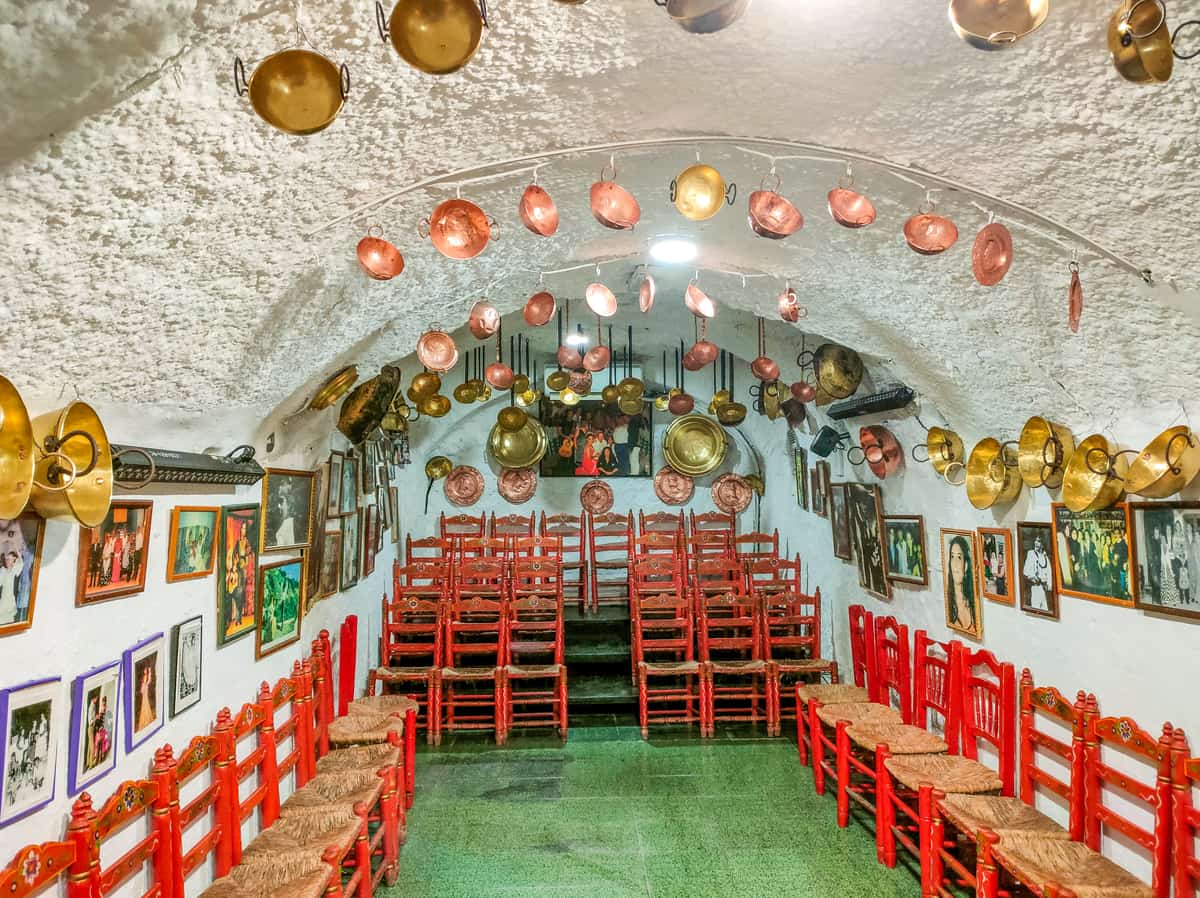
After Albaicín head to Sacromonte, another emblematic neighbourhood in Granada. Sacromonte is known for the troglodyte dwellings, or cave houses, and the flamenco. Sacromonte is the neghbourhood where the gitano subculture developed, mixed with Jewish and Muslim roots. The three ethnicities were marginalized and expelled outside of the city walls and settled on the Valparaíso hillside following the Reconquista of Granada in 1492.

There is no better place to see a flamenco show (affiliate link) than in one of the caves in Sacromonte. You can’t get closer to the the roots of flamenco and to what flamenco stands for than witnessing one of these explosions of passion, music and dance.
Fun fact: In 2010 flamenco was added by UNESCO to the List of Intangible Cultural Heritage of Humanity.
Most of the caves serve dinner before the flamenco show (affiliate link), and afterwards you can get some drinks. So that’s gonna be the perfect ending of the evening.
Day 2 in Granada: Historical Centre, Granada Cathedral, Hammam Al-Andalus
Summary of DAY 2
Morning: Puerta Real, Historical Centre, Alcaicería
Lunch: Bib-Rambla Square
Afternoon: Granada Cathedral, Royal Chapel, Calderería Nueva
Dinner: anywhere in the city
Evening: Hammam Al-Andalus
Start the day with a breakfast in one of Granada’s many lovely cafes and get out and about to explore the city. Granada’s city centre is pretty compact and walkable. Check out Fuente della Batallas on Plaza del Campanillo and head to Puerta Real crossing. Stay on the right side of the Reyes Católicos Avenue and wander the streets until you reach Plaza Isabel La Catolica. On the way you’ll pass by the lovely Town Hall with the square in front of it, and the beautiful Corral del Carbón – a 14th-century caravanserai with a tranquil patio.

Now cross the Reyes Católicos Avenue and head to the Alcaicería – the lively bazaar in the style of the North-African souks. Well, this bazaar was actually a silk market which emerged during the Nasrid period (13th – 15th c.). However, the original market burnt down in a fire in 1843. It was rebuilt later and this is how we know it today.
When you get out of the Alcaicería it will be time for lunch. So, head to the lovely Square of Bib-Rambla (Plaza de Bib Rambla/Bibarrambla), where you can get lunch at one of the numerous cafes under the shades of the trees.

Plaza de Bib-Rambla is one of the most important squares of Granada. It’s there where the celebrations took place in the past, and it was also used for bull-fighting. In the middle of the square is the Fountain of the Giants (La Fuente de los Gigantones). This 17th century fountain travelled around the city to finally find its place at Plaza de Bib-Rambla in 1940.
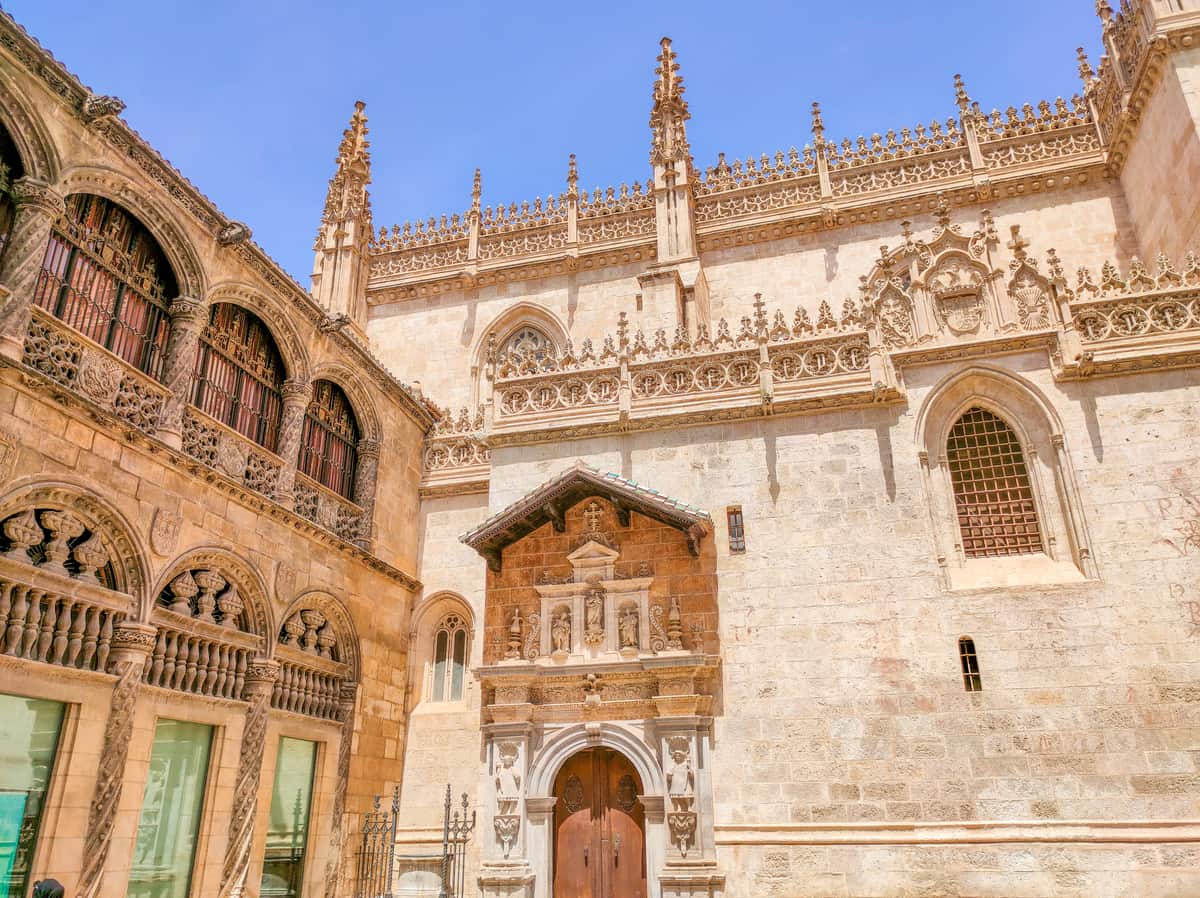
After lunch it’s time for the Granada Cathedral (affiliate link) (Catedral de Granada) and the Royal Chapel (affiliate link) (Capilla Real de Granada). The Cathedral was built in the 16th century on the place of the main mosque of Granada. At the Royal Chapel are the tombs of Isabella I of Castille and her husband Ferdinand II of Aragon, known together as the Catholic Monarchs.
Fun fact: It was Isabella I who sponsored the trip of Christopher Columbus to the East Indies in 1492, that eventually led to discovering the New World.
Next to the Cathedral is another important building in Granada – the Madrasa of Granada (Palacio de la Madraza) – a school founded in 1349 by the Yusuf I. And if you are into abstract art, you can visit Centro José Guerrero, where you can admire some of the works of this Spanish expressionist.
Another lovely place in Granada is Calderería Nueva Street (Calle Calderería Nueva). Going uphill towards Albaicín, this quaint narrow street lined up with small artisan shops, and the famous tearooms (teterías), will play with your senses, making you think you are walking a street somewhere in Morocco. At the end of the street is the lovely Church of San Gregorio.

For dinner there are many options to choose from: from fine dining to tapas, and to Mediterranean cuisine, and anything in between. A great option would be to join a tapas tour (affiliate link) or an evening walking food tour. This is a great opportunity to meet other people and to taste different dishes in pre-selected bars by knowledgeable locals.
After dinner, you may choose to get drinks at a bar, however there’s something else that you’d better do. You can’t visit Granada without this one last thing to do – a visit to a hammam. There’s nothing better than the rejuvenating experience of the hammam combined with a massage to end this two days in Granada full of walking along cobbled streets. We can highly recommend Hammam Al Ándalus (affiliate link), located just behind the Church of Santa Ana.
Where to stay in Granada?
If you are like me, doing a ton of research before you choose a place to stay, then finding accommodation in Granada will be overwhelming, especially if you are a first-timer and you don’t know the city.
So, let me help you get on the right track. It all starts with what you want, when you’ll be travelling and what’s your budget.

One of the most popular areas to stay in Granada is the quaint Albaicín. This full of charm neighbourhood in Granada may seem a no-brainer choice, but it comes with a few downsides: slippery cobblestone streets, no door-to-door transportation, as most of the streets are pedestrian only, and lots of climbing involved. Just imagine dragging your 20-kg wheeled suitcase uphill to reach your hotel…
On the other hand, if you travel light, let’s say with just a small backpack, as you are visiting Granada for 2 days, and charm and authenticity is what you are looking for, then staying in Albaicín would be the perfect choice for you! Use the map below to find your accommodation in Albaicín:
The best place to stay in Granada, however, is the city centre (El Centro). All bars and restaurants, as well as tourist attractions, are within a walking distance, but what’s more important, you can easily get to and from your hotel by public transport or a taxi.
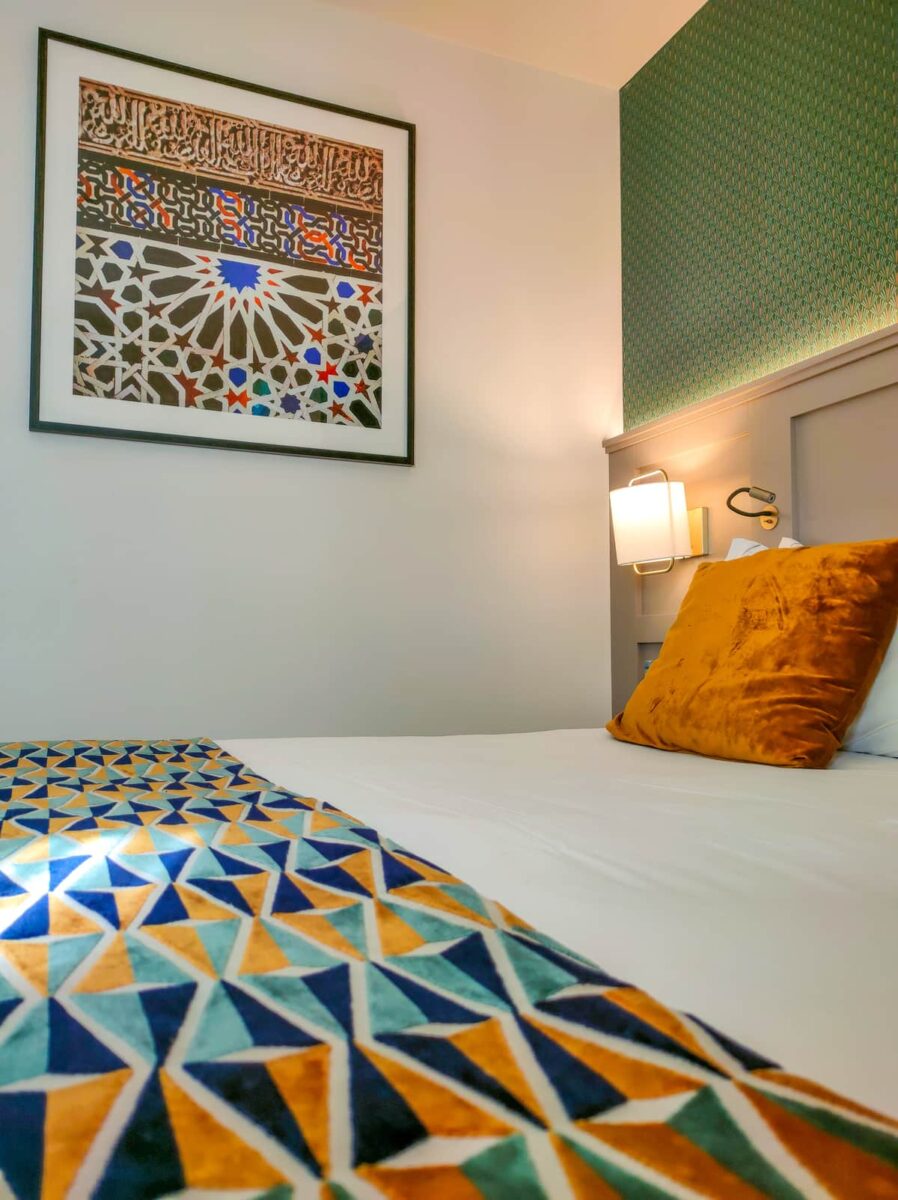
We highly recommend Eurostars Puerta Real (affiliate link), a 4-star hotel, located right in the heart of the city. Besides the perfect location, the rooms are quite spacious and decorated stylishly in the colors of Alhambra. They serve a lovely continental breakfast with a touch of Andalusian cuisine at the hotel and offer a late check-out, which is perfect, if you have a late-afternoon or an evening flight from Málaga.
Check out what other travellers say about this hotel on Tripadvisor.
Tips for Granada in 2 days
- If you are visiting Granada in the weekend, it’s better to visit the Cathedral and the Royal Chapel in the afternoon of the 2nd day, as the Cathedral is open only after 14:00 hrs for visitors on Sunday. Buy your Granada Cathedral tickets here (affiliate link).
- Don’t forget to bring your passport or ID card when visiting Alhambra! Otherwise you won’t be able to enter the complex.
- As visiting the Nasrid Palaces is with a timeslot, book your Alhambra tickets way in advance. Don’t rely on popping up there and buying a ticket. Already booked your Granada trip? Buy your Alhambra ticket here (affiliate link)!
- When visiting Granada, just don’t rent a car.
- Research well before you book a hotel. Most important is to check the accessibility: how you can get there by bus or by taxi. See above our recommendations for the best areas to stay in Granada.
- If you are arriving on Friday evening and leaving Sunday afternoon, then we suggest that you do the Flamenco show with dinner on the first evening when you arrive and the hammam experience on Saturday evening. For the rest you can follow the 2-day Granada itinerary as suggested.